Working Over Water with EWPs: Why Specialist Planning, Equipment, and Certification Matter
Operating Elevating Work Platforms (EWPs) over or near water introduces a set of risks that go well beyond standard height‑safety considerations. In marine, port, river, coastal, and infrastructure environments, hazards such as ground instability, tidal movement, vessel wake, weather exposure, and water rescue complexity demand a far higher level of planning, competency, and equipment assurance than conventional worksites.
At EHL, working over water is a dedicated operational focus, supported by specialist facilities, trained personnel, and a structured compliance framework that aligns with EWPA New Zealand industry guidance and current best practice.
Why “Working Over Water” Is a Distinct Risk Category
EWPA NZ clearly identifies that operating Mobile Elevating Work Platforms (MEWPs) over or near water presents additional hazards, including the potential for personnel, equipment, or entire platforms to enter the water.
Key risks include:
- Platform occupants falling into water
- MEWP instability due to soft, eroded, or saturated ground
- Sudden changes in tide, flow, or flood conditions
- Difficult or delayed rescue scenarios
- Conflicting risk controls between fall‑from‑height and drowning hazards
Because of this complexity, EWPA requires that risks be managed through a site‑specific risk management plan, prepared by a competent person and formally documented prior to work commencing.
This is not an administrative exercise—it is fundamental to preventing severe injury or fatal outcomes.
The Importance of Equipment Selection and Site Assessment
Selecting the correct MEWP is critical when working over water. According to EWPA guidance, equipment selection must account for:
- Ground bearing pressure (including tyre vs tracked machines)
- Likelihood of subsidence or erosion
- Environmental conditions such as wind, rain, and flooding
- Travel prevention measures
- Rescue access and retrieval options
At EHL, these considerations are embedded into our inspection, certification, and advisory processes, ensuring machines deployed into water‑adjacent environments are fit‑for‑purpose—not simply compliant on paper.
Working from Barges, Pontoons, and Floating Structures
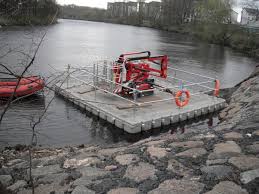
Operations involving MEWPs mounted on barges or pontoons introduce some of the highest‑risk scenarios in the EWP environment.
EWPA requires that a competent person, such as a naval architect, assess whether:
- The vessel can support the MEWP’s weight, point loads, and moving loads
- The combined system remains stable under worst‑case conditions
- Tide, depth, wave action, water flow, floods, and vessel wake have been properly considered
- Chassis inclination remains within the manufacturer’s limits at all times
In addition, safeguards must be in place to prevent the MEWP from inadvertently travelling over the vessel’s edge, and machines should only operate at creep speed during setup.
EHL regularly supports clients operating from marine platforms, ports, and water‑based infrastructure by ensuring:
- Equipment certification is current and appropriate
- Engineers understand manufacturer limitations in dynamic marine environments
- Deployment plans align with both structural and operational risk controls
Working Near Water: Ground, Stability, and Ongoing Monitoring
Even when MEWPs are not directly over water, proximity introduces instability risks.
EWPA guidance identifies hazards including:
- Tipping into water
- Embankment or riverbed failure
- Erosion around wheels and outriggers
- Unpredictable changes in ground conditions caused by water flow
Control measures include:
- Setting up on firm, level surfaces
- Using larger spreader boards under outriggers
- Continuous monitoring of ground conditions during operation
- Ensuring outrigger feet remain properly centred
- Wearing a harness when positioned over ground (where drowning risk is low)
EHL’s servicing and inspection teams are trained to identify these risk factors before machines are mobilised, not after incidents occur.
Harness or Life Jacket? The Critical Safety Decision
One of the most misunderstood aspects of working over water is personal fall protection selection.
EWPA guidance requires a specific risk assessment to determine whether:
- The risk of drowning outweighs the risk of falling from height, or
- Conventional fall‑arrest systems are appropriate
Where drowning risk is greater:
- Life jackets or personal flotation devices (PFDs) compliant with AS4758.1 should be worn
- Fall risk should be controlled by alternative means, not harnesses
- Harnesses and flotation devices must not be worn simultaneously
This is critical because a person falling into water while attached to a lanyard may be unable to detach themselves, rapidly escalating the severity of the incident.
EHL works closely with operators and site managers to ensure these decisions are understood, documented, and correctly implemented.
Rescue Planning Is Non‑Negotiable
EWPA guidance is explicit: when working over or near water, a rescue plan must be in place.
This includes:
- Methods for retrieving a submerged platform
- Procedures for rescuing a person from the water
- Readily accessible life buoys
- Use of spotters, clear communications, and rescue boats positioned outside drop zones
At EHL, rescue planning is treated as a core functional requirement, not a tick‑box exercise.
Why EHL Is Different
EHL is not a generalist provider. We are a New Zealand‑focused EWP service and certification specialist with:
- A dedicated “working over water” division
- Facilities designed to support marine and water‑adjacent operations
- Inspectors and engineers trained in complex deployment environments
- Deep familiarity with EWPA NZ guidance and practical application
We support clients across:
- Ports and terminals
- Coastal and river infrastructure
- Marine construction and maintenance
- Utilities, energy, and industrial sites
Our role is to ensure EWPs are not only certified—but genuinely safe for the conditions they operate in.
Final Word: Compliance Is the Baseline—Competence Is the Difference
Working over water demands more than standard EWP compliance. It requires:
- Proper risk assessment
- Correct equipment selection
- Informed personal protection decisions
- Robust rescue planning
- Experienced, competent oversight
At EHL, this is our everyday work.
If your next project involves EWPs over or near water, engage a provider that understands the difference between height risk and water risk—before the job starts.
📞 Talk to EHL
To discuss working over water EWP certification, servicing, or advisory support, contact EHL today and speak with our specialist team.
+64 6 755 2412
solutions@ehlsolutions.com