
A Stable Regional Base for Critical Marine and Industrial Engineering and Fabrication
Global supply chains are under pressure. Geopolitical conflict, disrupted shipping routes, changing trade conditions and longer equipment lead times are forcing businesses to reconsider where critical engineering and fabrication work is sourced.
For shipbuilders, defence contractors and industrial operators, the question is no longer simply where equipment can be manufactured. It is how to build a more resilient supply chain, maintain control over critical work packages and secure dependable engineering support throughout an asset’s operational life.
Australia and New Zealand offer a compelling regional base for collaboration, supported by established industrial capabilities, skilled engineering teams and access to the wider Asia-Pacific market.
EHL works with customers and industry partners to support marine and industrial engineering, custom fabrication, equipment integration, project delivery and lifecycle maintenance.
Discover how regional collaboration can help turn supply chain uncertainty into an opportunity to strengthen capability, improve coordination and build long-term industrial relationships.
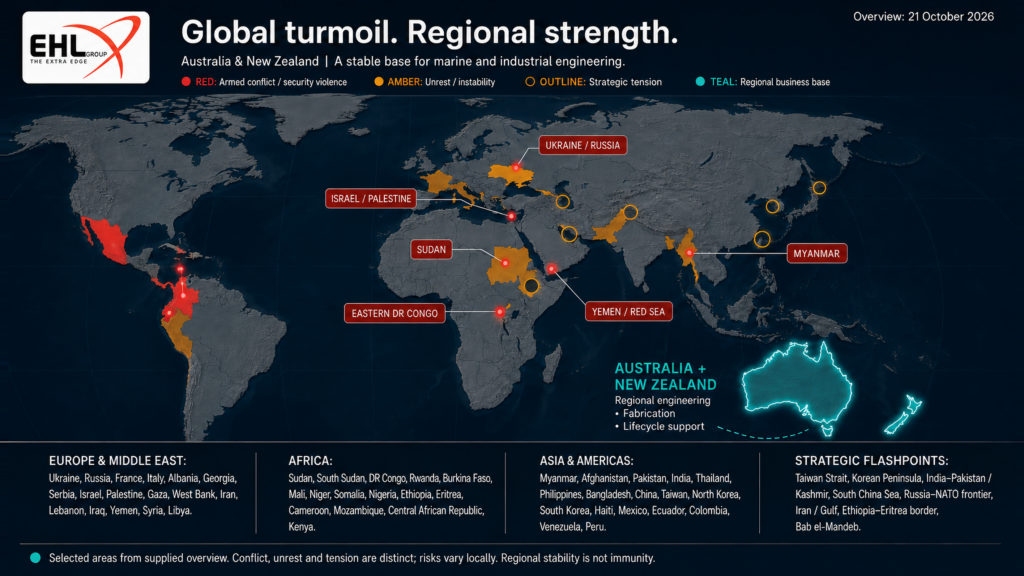
Global uncertainty is changing the way businesses think about supply chains
The past several years have demonstrated how quickly global events can affect the movement of goods, the availability of equipment and the delivery of major industrial projects.
The COVID-19 pandemic exposed vulnerabilities in extended international supply chains. Russia’s invasion of Ukraine in 2022 disrupted established energy, commodity and trade flows. From late 2023, attacks on commercial shipping in the Red Sea forced vessels to divert from the Suez Canal route, while drought-related restrictions affected shipping through the Panama Canal during 2023 and 2024.
These events arose from different causes, but they highlighted a common challenge: when critical equipment, materials or manufacturing capacity depend on vulnerable international supply routes, a disruption in one region can affect projects thousands of kilometres away.
The United Nations Conference on Trade and Development (UNCTAD) documented how disruption across the Red Sea, Black Sea and Panama Canal contributed to longer shipping routes, increased costs and pressure on global maritime supply chains. Its Review of Maritime Transport 2024 reinforced the importance of improving the resilience of maritime transport and supply networks.
For businesses responsible for vessel construction, defence capability, industrial plant and critical infrastructure, these are not simply international trade issues. They can become practical project challenges involving delivery schedules, equipment availability, maintenance planning and the ability to keep assets operational.
The question is therefore worth asking:
Could a stronger regional engineering and fabrication partnership help your business reduce exposure to supply chain disruption while creating new opportunities for collaboration?
Why regional engineering and fabrication capability matters
Global sourcing remains essential to modern manufacturing. International suppliers provide specialist components, advanced materials and manufacturing capacity that cannot always be replicated locally.
However, relying on a single supplier, manufacturing location or extended transport route can introduce risks that are difficult to control once a project is underway.
A more resilient approach considers not only where equipment is purchased, but also where it can be engineered, fabricated, assembled, maintained, modified and supported throughout its operational life.
For marine and industrial projects, regional engineering and fabrication capability can offer several practical advantages.
1. Greater control over project coordination
Working with an engineering and fabrication partner in the Australia–New Zealand region can make it easier to coordinate technical discussions, design reviews, manufacturing schedules and project interfaces.
Closer collaboration can help engineering teams address changes in requirements, resolve fabrication issues and manage interfaces before they become more expensive problems during installation or commissioning.
Regional delivery does not eliminate project risk, but it can provide a more direct working relationship between the customer, engineering team and fabricator.
2. Reduced exposure to some international logistics risks
Marine and industrial equipment can involve large structural assemblies, custom-fabricated components, hydraulic systems and specialised machinery. Transporting these items across multiple international supply routes can add cost, handling requirements and schedule uncertainty.
Where the required capability and materials are available regionally, local or regional fabrication may reduce dependence on particular overseas manufacturing locations and long-distance transport for selected work packages.
The appropriate sourcing strategy will still depend on material availability, component specifications, manufacturing capacity and the commercial requirements of each project.
The objective is not to eliminate international suppliers. It is to create additional options where regional engineering and fabrication can provide genuine value.
3. Improved access to technical support
Equipment delivery is only one part of the asset lifecycle.
Critical systems may subsequently require inspections, repairs, modifications, replacement components, performance improvements or refurbishment. Access to a regional engineering partner can help customers plan and coordinate these activities without treating every requirement as a new international procurement exercise.
For vessel operators and industrial asset owners, this can be particularly relevant where equipment availability, maintainability and the timely resolution of technical issues influence operational performance.
4. Stronger regional industrial capability
Regional manufacturing and engineering partnerships can also create value beyond an individual contract.
By working together, engineering businesses, specialist fabricators, equipment suppliers and larger project contractors can combine their respective capabilities to deliver work packages that may be difficult or inefficient for one organisation to complete independently.
This creates opportunities to build supplier relationships, develop technical capability, support regional industry and pursue larger domestic and international projects.
Australia and New Zealand: a regional platform for collaboration
Australia and New Zealand cannot be isolated from global economic conditions, geopolitical developments or international shipping disruption. Both countries depend on international trade, imported materials and components, and access to global markets.
Their strategic advantage is not immunity from disruption. It is the opportunity to use established industrial capabilities, regional relationships and coordinated engineering resources to provide additional options for customers.
The two countries also have a clear interest in strengthening cooperation across defence, manufacturing and critical supply chains.
In December 2024, Australia and New Zealand reaffirmed their commitment to closer defence relations, including collaboration on defence industry, capability acquisition and sustainment. The joint statement identified industrial cooperation as a way to build supply chain resilience and support evolving maritime security requirements.
In March 2026, New Zealand’s Ministry of Defence also outlined further work to strengthen supply chain resilience and domestic industrial capability through its Strategic Industrial Base Statement on uncrewed systems and counter-systems.
These policy developments demonstrate a wider recognition that industrial capability, supply chain resilience and effective partnerships matter to long-term national and commercial objectives.
For shipbuilders, defence contractors, marine equipment suppliers and industrial businesses, this creates a constructive opportunity to consider how Australian and New Zealand engineering and fabrication capabilities can complement existing supply chains.
The opportunity is not necessarily to replace an established overseas supplier. It may be to add a regional manufacturing partner, develop a second source for selected components, support an existing project team or establish a practical pathway for future maintenance and sustainment.
Where EHL can contribute
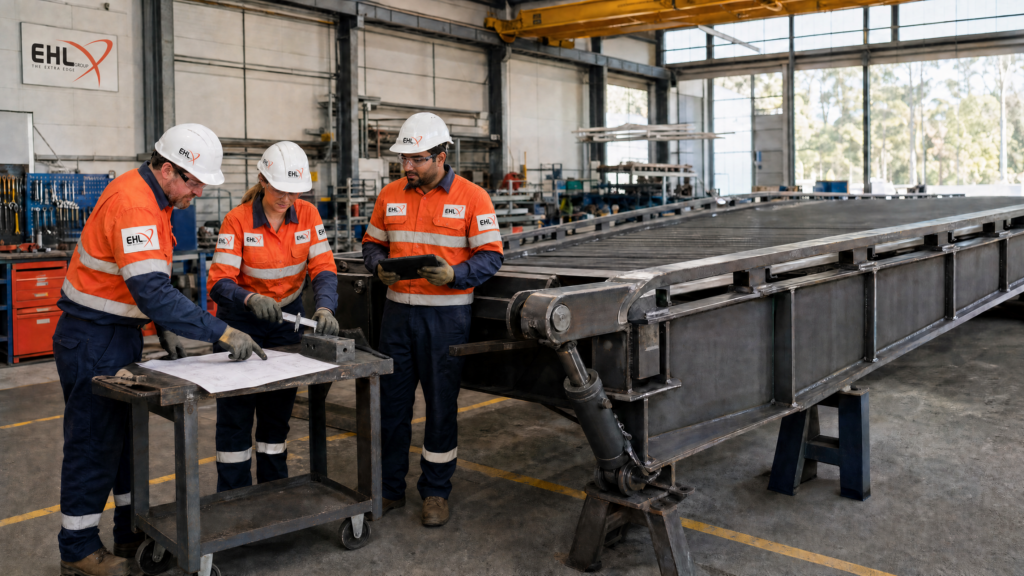
EHL works across marine and industrial engineering, design collaboration, fabrication, installation support, servicing and lifecycle maintenance. Its team can work with customers to assess requirements and establish a project-specific scope suited to the equipment, operating environment and intended outcome.
EHL’s Australia–New Zealand presence provides a regional base for customers seeking to explore collaborative approaches to engineering and manufacturing.
Depending on the project, opportunities may include the following.
Marine engineering and vessel equipment
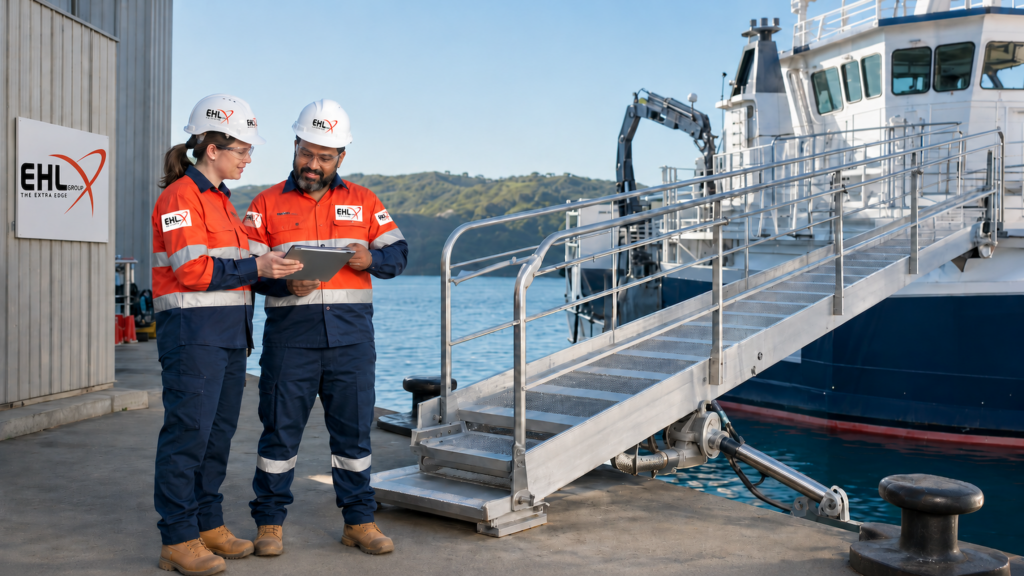
EHL can support specialist marine access and structural equipment, including:
- Landing craft ramps and heavy-duty vessel ramps.
- Hydraulic vessel doors, shell doors and bulkhead doors.
- Marine gangways and personnel access systems.
- Cantilevered access structures.
- Load-offload and stabilisation systems.
- Associated hydraulic, structural and mechanical interfaces.
These systems require careful consideration of vessel geometry, structural loads, actuation, operating conditions, installation interfaces and maintenance access.
Working with EHL during early design or project planning can help customers explore how equipment engineering and fabrication requirements can be coordinated with the wider vessel programme.
Custom industrial engineering and fabrication
Industrial projects often involve equipment or assemblies that must be designed or modified to suit a particular plant, process, operating environment or installation constraint.
Collaborative work packages may involve custom fabrication, structural assemblies, hydraulic equipment, equipment modifications, component replacement and engineering support for existing assets.
For businesses managing labour shortages, manufacturing constraints or demanding project schedules, working with an external engineering and fabrication partner may provide additional capacity without requiring every capability to be maintained internally.
The appropriate scope depends on the available resources, technical requirements and delivery expectations of each project.
Project delivery and engineering support
Engineering projects frequently require coordination across several disciplines, suppliers and contractors. A delay in one work package can affect downstream installation, commissioning and operational readiness.
EHL can work with customers to define deliverables, review technical requirements, coordinate fabrication activities and establish the documentation and inspection requirements appropriate to the agreed scope.
This collaborative model can help project teams identify constraints earlier and allocate work more effectively across the organisations involved.
Maintenance, refurbishment and lifecycle support
Supply chain resilience should also consider what happens after equipment enters service.
When critical equipment requires repair, refurbishment or modification, a regional engineering partner may help assess the problem, develop a suitable scope and coordinate the work required to return the equipment to service.
For marine and industrial operators, this can support more deliberate maintenance planning and provide an additional option for managing equipment throughout its working life.
Collaboration, not simply outsourcing
The greatest opportunity may lie in how organisations work together rather than in where a single component is manufactured.
A shipbuilder may have the vessel design authority but need additional fabrication capacity for a specialist assembly. An equipment manufacturer may have a proven product but require a regional partner for custom structural work, installation support or ongoing maintenance. An industrial contractor may have secured a project but need additional engineering resources to deliver a defined work package on schedule.
In each case, the requirement is different. The principle is the same: combine complementary capabilities to deliver work more effectively.
EHL welcomes discussions with organisations looking to explore collaborative project delivery, regional fabrication, engineering support and long-term equipment servicing.
Potential arrangements can be considered on a project-by-project basis, with clear agreement on design responsibility, technical approvals, quality requirements, inspection and testing, documentation, commercial terms and delivery obligations.
This is particularly important for defence and other safety-critical applications, where contractual requirements, applicable standards, traceability and acceptance criteria must be established from the outset.
A well-defined collaboration allows each organisation to contribute its strengths while maintaining clear accountability for the work it undertakes.
Turning supply chain uncertainty into a commercial opportunity
Supply chain resilience is often discussed in terms of risk reduction. It can also create opportunities for growth.
For international manufacturers, an Australian or New Zealand engineering and fabrication partner may provide a route to regional projects, additional manufacturing capacity or local technical support.
For shipbuilders and industrial contractors, collaboration may provide access to complementary skills and resources when internal teams are under pressure.
For equipment owners, regional engineering capability may offer additional options for refurbishment, modifications and lifecycle maintenance.
For Australian and New Zealand businesses, these relationships can support participation in larger projects, strengthen supplier networks and open pathways to international work.
The most effective partnerships begin with a clear understanding of the customer’s requirements, the capabilities available and the work that can realistically be delivered. They are built through technical competence, transparent communication, reliable project coordination and a shared commitment to meeting agreed requirements.
This is where early engagement matters. Discussing a potential work package before schedules become critical gives both parties more opportunity to assess the technical scope, resource requirements, manufacturing options and commercial case.
Building a more resilient engineering future with EHL
Global uncertainty is unlikely to disappear. International supply chains will continue to play an essential role in marine and industrial manufacturing, but businesses have an opportunity to reassess where additional regional capability can improve flexibility and support long-term delivery.
Australia and New Zealand offer a practical regional base for organisations seeking to strengthen engineering relationships, develop fabrication partnerships and explore alternative approaches to equipment support.
EHL is interested in working with shipbuilders, naval architects, defence contractors, equipment manufacturers, industrial operators and project delivery organisations to identify opportunities where its engineering, fabrication and lifecycle capabilities can complement their own.
Whether the requirement involves a specialist marine structure, a custom industrial work package, a component modification or ongoing equipment support, the first step is a conversation about the operational need and the most effective way to deliver it.
Looking for a regional engineering and fabrication partner?
Contact EHL to discuss your next marine or industrial project, explore collaborative work packages, or identify where Australia–New Zealand engineering capability could complement your existing supply chain.
EHL Group — engineering, fabrication and lifecycle support across Australia and New Zealand.
New Zealand: solutions@ehlsolutions.com | +64 6 755 2412
Australia: solutions@ehlsolutions.com | +61 421 380 442
Frequently Asked Questions: Regional Engineering and Fabrication in Australia and New Zealand
Why is regional engineering and fabrication important for supply chain resilience?
Regional engineering and fabrication can provide businesses with additional sourcing options, closer technical coordination and access to manufacturing and maintenance support. By diversifying suitable work packages across capable suppliers, organisations may reduce their exposure to individual overseas suppliers, transport routes and international logistics disruptions. The benefits depend on project requirements, material availability and the capabilities of the regional partner.
How have geopolitical conflicts affected marine and industrial supply chains?
Conflicts and security disruptions have affected shipping routes, freight costs, delivery schedules and the movement of critical goods. Examples include the war in Ukraine, attacks on commercial shipping in the Red Sea from late 2023, and associated disruption to Suez Canal traffic. Separately, drought-related restrictions affected the Panama Canal during 2023 and 2024. These events demonstrate why businesses should consider logistics resilience and alternative supply arrangements when planning critical projects.
Why consider Australia and New Zealand for marine and industrial engineering?
Australia and New Zealand offer established engineering and manufacturing capabilities, regional industry relationships and access to Asia-Pacific markets. Depending on the project, a regional partner may support custom fabrication, equipment integration, technical coordination, refurbishment and lifecycle maintenance. Regional sourcing can complement international supply chains rather than replace them entirely.
What marine engineering and fabrication services can EHL support?
EHL supports marine engineering, design collaboration, fabrication, installation support and lifecycle maintenance. Marine equipment applications include landing craft ramps, hydraulic vessel doors, shell doors, bulkhead doors, gangways, cantilevered access structures and load-offload stabilisation systems. The scope of work is established according to the project requirements and agreed responsibilities.
Can EHL collaborate with international shipbuilders and equipment manufacturers?
EHL can discuss project-specific collaboration with shipbuilders, naval architects, equipment manufacturers, defence contractors and other engineering businesses. Potential arrangements may include defined fabrication work packages, engineering support, equipment modifications, regional manufacturing and lifecycle servicing. Technical responsibilities, deliverables, quality requirements and commercial arrangements should be agreed before work commences.
Can regional fabrication help reduce project delays?
Regional fabrication may reduce reliance on particular overseas manufacturing locations or long-distance transport for suitable work packages. Closer coordination may also help resolve technical queries and manage design changes. However, delivery performance depends on factors including material availability, manufacturing capacity, design approval, project scheduling and logistics. Regional fabrication should be evaluated against the requirements of each project rather than assumed to guarantee shorter lead times.
How can businesses diversify their engineering supply chains without replacing existing suppliers?
Businesses can identify work packages that could be supported by an additional qualified engineering or fabrication partner. This may include custom structural assemblies, selected equipment components, modifications, refurbishment or regional maintenance support. A staged approach allows organisations to assess technical capability, quality systems, delivery performance and commercial suitability while retaining existing supplier relationships where they remain effective.
What should businesses assess when selecting a marine or industrial fabrication partner?
Important considerations include relevant engineering experience, manufacturing capability, materials and component availability, quality assurance, inspection and testing requirements, technical documentation, traceability, delivery capacity, safety requirements and lifecycle support. For defence or safety-critical projects, applicable standards, design authority, contractual obligations and acceptance criteria must also be clearly established.
How can EHL support industrial projects experiencing labour or engineering capacity constraints?
EHL can discuss defined engineering, fabrication and equipment work packages with businesses that need additional project resources. Depending on the scope, collaboration may help supplement internal engineering teams, address fabrication requirements, coordinate equipment modifications or support delivery commitments. Suitability depends on the technical requirements, available capacity and agreed programme.
How can a business begin working with EHL?
Businesses can contact EHL to discuss the project scope, operating requirements, equipment specifications, drawings, schedule, fabrication needs and documentation expectations. Early engagement allows both parties to assess whether EHL’s engineering, fabrication and lifecycle capabilities are suitable for the proposed work and establish a clear basis for collaboration.