
Why Stowage Space Matters More Than You Think
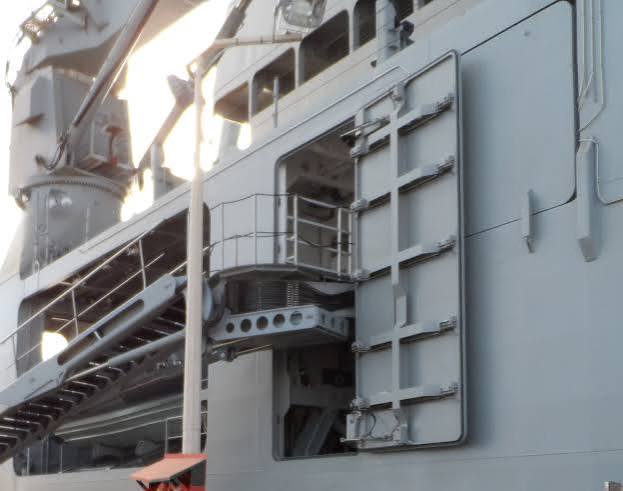
For naval architects and vessel designers, integrating a marine gangway is not simply a question of achieving the required outreach. The engineering challenge is ensuring the system can transition between its operational and stowed configurations without compromising deck utilisation, structural arrangements, equipment access or the vessel’s overall functional envelope.
Gangway geometry, folding kinematics, hydraulic actuation, support reactions and securing arrangements must be considered alongside surrounding structure, pipework, cable runs, access routes and adjacent equipment. Inadequate consideration during early design can introduce spatial conflicts, restrict maintenance access, complicate installation or force costly modifications during vessel construction or refit.
Effective stowage design therefore demands more than finding an available space. It requires coordinated consideration of the complete operating envelope, structural interfaces, serviceability and integration with the vessel’s architecture.
Explore how early engineering decisions around gangway stowage can reduce integration risk, protect valuable deck space and improve long-term vessel operability.
The Hidden Engineering Challenge Behind Marine Gangways
Introduction
When people discuss gangway performance, they usually think about deployed length, load capacity and operating speed.
But one of the most important engineering challenges occurs when the gangway is not being used.
Where does it go?
How much space does it occupy?
What equipment sits around it?
Can technicians access it?
Does it interfere with doors, machinery or crew movement?
Stowage is therefore not simply a packaging problem.
It is a vessel-design problem.
The Stowed Envelope
Every access system has a physical envelope.
That envelope changes as the equipment:
- extends
- rotates
- lifts
- lowers
- folds
- retracts
- deploys handrails
The design therefore needs to consider both:
Operating envelope
and
Stowage envelope.
A system can be perfectly capable when deployed and still be unsuitable because of its stowed configuration.
Vessel Space Is Valuable
Modern vessels are densely engineered.
Available space is allocated to:
- machinery
- accommodation
- stores
- piping
- electrical systems
- ventilation
- structural elements
- access routes
- safety equipment
Adding a gangway means competing with all of these requirements.
Compact engineering can therefore provide significant value.
EHL’s published accommodation-ladder capability specifically identifies compact stowage and vessel-specific configuration as design considerations. (EHL Group)
Stowage Affects Maintenance
A gangway that is difficult to access when stowed can create maintenance problems.
Technicians need safe access to:
- pivots
- cylinders
- bearings
- hydraulic connections
- electrical components
- sensors
- structural inspection points
Maintenance access should therefore be considered alongside the equipment envelope.
Stowage and Structural Integration
The stowed position also determines how loads are transferred into the vessel.
Design may need to account for:
- support points
- locking mechanisms
- deck reinforcement
- pivot structures
- vibration
- transport loads
- sea-state effects
This is another reason why the access system should be considered during vessel design rather than after the layout has already been fixed.
The Retrofit Challenge
Existing vessels create an additional challenge.
The designer may have to work around:
- existing deck penetrations
- machinery
- structural members
- piping
- cables
- restricted access
- legacy systems
In these circumstances, the stowed envelope can become the dominant design constraint.
Compact Does Not Mean Compromised
A compact system should not simply be one that has been made smaller.
The engineering objective is to optimise:
Performance
against
Available space.
That can involve:
- geometry
- folding arrangements
- material selection
- actuator positioning
- handrail configuration
- mounting location
Design the Stowed Position First?
For some applications, this can be a useful engineering philosophy.
Start with:
Where must the equipment live?
Then determine:
How does it get from there to the operating position?
This approach forces the designer to address integration early.
Conclusion
A gangway is only deployed for part of its service life.
For the remainder of the time, it occupies valuable vessel space.
The best designs therefore optimise both positions:
where the gangway operates
and
where the gangway lives.
That is why stowage should be treated as a primary engineering parameter — not an afterthought.
Contact: solutions@ehlsolutions.com
FAQ
Should I choose a manual or automated marine gangway?
The choice depends on the vessel’s operating frequency, gangway size, load, available power, crew requirements, environmental conditions and desired level of automation. There is no single configuration that is optimal for every vessel.
What are the advantages of a hydraulic marine gangway?
Hydraulic actuation can provide high force density and controlled movement, making it suitable for large or heavy marine access systems. Hydraulic architecture can also be integrated with other vessel hydraulic systems where appropriate.
What are the advantages of an electrically actuated gangway?
Electric actuation can provide precise control and can be appropriate where electrical infrastructure is available and hydraulic systems are not preferred. Motor sizing, braking, environmental protection and emergency operation still need to be addressed.
What is a hybrid marine gangway?
A hybrid marine gangway combines different actuation, power or control technologies to achieve specific operational requirements. The architecture can be tailored to balance automation, redundancy, energy requirements, manual recovery and vessel constraints.
Are hydraulic gangways better than electric gangways?
Neither technology is universally better. The appropriate solution depends on the vessel’s load requirements, operating environment, available infrastructure, control requirements, maintenance philosophy and lifecycle objectives.
What should be considered when selecting gangway actuation?
Key considerations include load, geometry, duty cycle, operating speed, available power, space, environmental exposure, control requirements, emergency operation, maintenance and lifecycle support.
Can EHL design different types of marine gangway actuation systems?
EHL can engineer marine access systems using different mechanical, hydraulic, electrical and automated configurations according to the specific vessel and operational requirements.