The Gangway Is Not a Piece of Deck Equipment
A gangway may sit on the deck. Its engineering doesn’t stop there.
Structure, hydraulics, electrical systems, controls, safety interlocks and human factors can all become part of the access-system equation.
We examine why treating a marine gangway as a complete vessel system can lead to better integration, operation and lifecycle performance.

Why Marine Access Should Be Engineered as a Vessel System
Introduction
A marine gangway or accommodation ladder may appear to be a relatively straightforward piece of vessel equipment. It provides access between a vessel and a quay, another vessel or a shore-based facility, and then retracts or stows when no longer required.
However, the engineering behind an effective marine access system extends well beyond the visible structure.
A modern marine gangway can involve structural engineering, hydraulic systems, electrical power, automation, controls, sensors, safety systems, vessel geometry and human factors. Each of these elements must work together within the operating environment of the vessel.
The important question is therefore not simply:
“What gangway can we install?”
It is:
“What marine access system should be engineered around this vessel and its operational requirements?”
That distinction can have a significant impact on safety, reliability, maintainability and long-term performance.
Marine Gangway Design Starts With the Vessel
A vessel-specific approach begins by understanding how the access system needs to operate.
Before a marine gangway or accommodation ladder is selected or designed, engineers need to consider factors such as:
- available deck and structural space
- required gangway length and operating envelope
- vessel freeboard
- landing position
- expected vessel movement
- operating loads
- deployment frequency
- stowage requirements
- hydraulic and electrical infrastructure
- operator requirements
- emergency operation
- inspection and maintenance access
- environmental exposure
- applicable standards and project requirements
These considerations influence the mechanical design, actuation system, controls and mounting arrangement.
A gangway that performs well on one vessel may be entirely unsuitable for another.
Marine access equipment therefore needs to be engineered around the vessel rather than treated as a generic item of deck equipment.
The Interfaces Matter
Consider a hydraulically actuated accommodation ladder.
The ladder structure does not operate independently. It interfaces with:
- vessel deck foundations
- pivots and bearings
- hydraulic cylinders
- hydraulic power units
- valves and manifolds
- hoses and pipework
- electrical systems
- control systems
- position sensors
- safety interlocks
- emergency systems
Every one of these interfaces introduces an engineering requirement.
If they are designed independently, the final system may function, but it may also become unnecessarily complex, difficult to maintain or inefficient to operate.
Integrated engineering considers these interfaces from the beginning.
The objective is not simply to make each individual component work.
It is to make the complete marine access system work as one coordinated system.
Structural Integration of Marine Gangways
A marine gangway transfers significant forces into the vessel structure.
Depending on the application, the supporting structure may need to accommodate:
- static loads
- dynamic loads
- cantilever loads
- deployment and retraction forces
- reaction loads
- repeated operating cycles
- environmental loads
- localised structural stresses
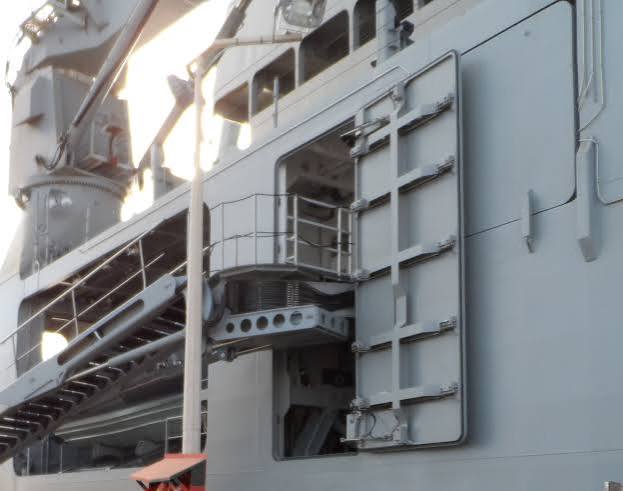
The gangway foundation, pivot arrangement and supporting structure therefore form part of the overall vessel engineering.
A practical example
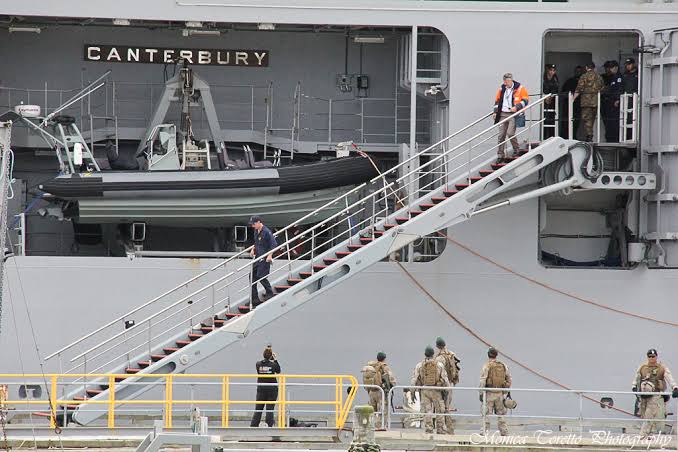
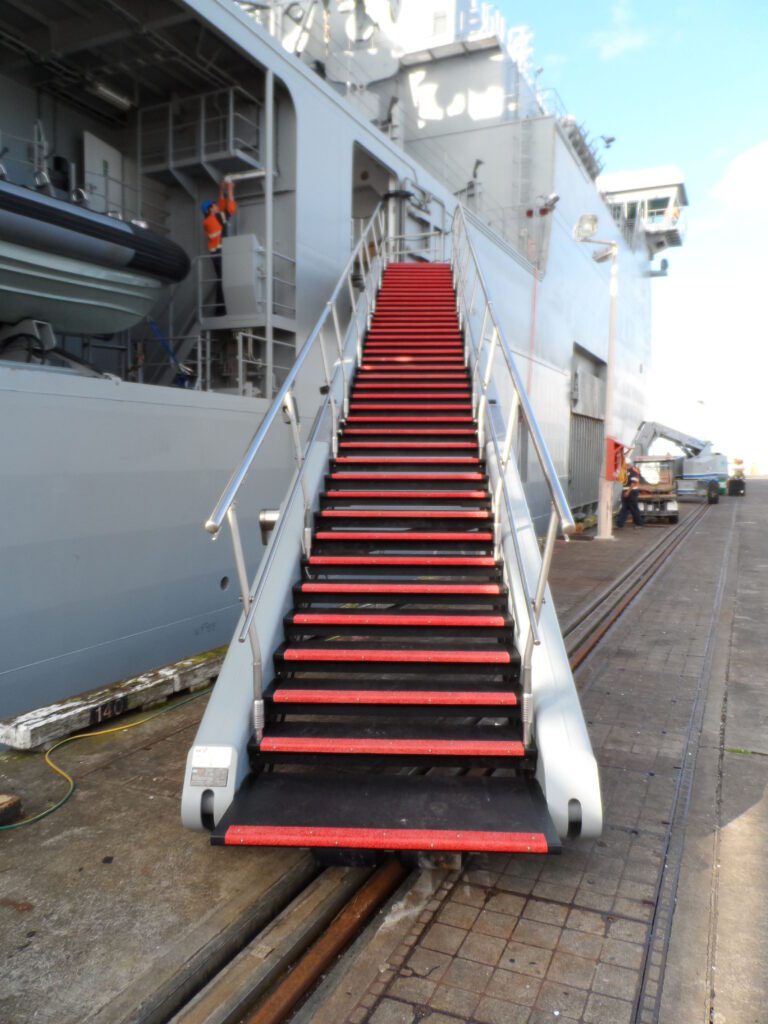
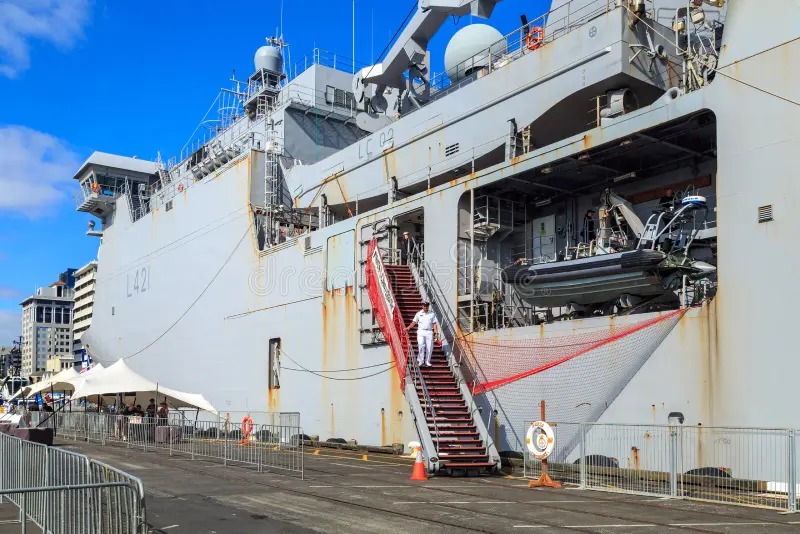
EHL’s HMNZS Canterbury accommodation ladder demonstrates the scale of engineering that can be involved in a naval marine access system.
The published system is approximately 14.5 metres long, weighs approximately 12 tonnes and has a supported load capacity of 6,000 kg. EHL Group — HMNZS Canterbury Accommodation Ladder
That is more than a ladder mounted to a ship.
It is a substantial engineered structure that must operate as part of the vessel.
This is why structural integration needs to be considered at the beginning of the design process.
Hydraulic Integration
Hydraulics are commonly used to control large and heavy marine access equipment because they can provide substantial force within a relatively compact arrangement.
However, a hydraulic marine gangway introduces its own engineering requirements.
These can include:
- pressure and flow requirements
- cylinder sizing
- valve selection
- hydraulic power-unit capacity
- hose and pipe routing
- filtration
- pressure management
- load holding
- emergency operation
- leakage control
- maintenance access
The hydraulic system therefore cannot be considered separately from the mechanical structure.
Cylinder geometry, attachment points, available movement and required operating speed all influence hydraulic-system design.
EHL’s marine engineering capability includes hydraulic power units, hydraulic systems, manifolds, cylinders and associated hydraulic components. EHL Group — Maritime Team
This allows mechanical, hydraulic and control requirements to be considered together rather than treated as isolated disciplines.
Electrical and Control System Integration
Automation introduces another layer of engineering into marine access systems.
Depending on the application, an automated gangway or accommodation ladder may incorporate:
- PLC control
- position sensing
- pressure monitoring
- limit switches
- emergency stops
- operator interfaces
- remote controls
- safety interlocks
- fault monitoring
The objective should not simply be to automate movement.
The objective should be controlled, predictable and safe operation.
A well-designed control system should give the operator a clear understanding of:
- system status
- current position
- movement
- operating limits
- faults
- alarms
- emergency conditions
The control architecture should also take account of what happens if a sensor, power supply, hydraulic system or control component fails.
Human Factors Are Part of the Engineering
Technology does not automatically make a marine access system easier or safer to operate.
A technically sophisticated system can still be poorly designed if the operator interface is confusing or requires unnecessary intervention.
Good human-factor engineering asks practical questions:
- What does the operator need to see?
- How many controls are required?
- Is system status immediately apparent?
- Are operating limits clear?
- What happens when a fault occurs?
- Can the system be safely stopped?
- Can it be recovered following a failure?
- Does operation require excessive physical effort?
Reducing unnecessary operator interaction can improve usability and reduce opportunities for operating error.
The best control system is not necessarily the one with the most functions.
It is the one that gives the operator the right information and the right level of control at the right time.
Environmental Conditions Are Design Inputs
Marine equipment operates in an environment that can be considerably more demanding than typical land-based industrial equipment.
Marine gangway design may need to account for:
- saltwater exposure
- corrosion
- wind
- rain
- temperature variation
- tidal changes
- vessel movement
- wet surfaces
- contamination
- repeated loading
These conditions can influence material selection, protective coatings, component selection, sealing, electrical protection and maintenance requirements.
The operating environment should therefore be established during the design phase.
It is not an afterthought. It is an engineering input.
Why System-Level Testing Matters
Testing individual components is important.
Testing the complete system is essential.
A hydraulic cylinder may operate correctly.
A PLC may function correctly.
A sensor may provide the expected signal.
The gangway structure may satisfy its individual engineering requirements.
Yet the complete system can still experience an operational problem at the interface between these components.
For this reason, commissioning should consider the complete sequence of operation.
Depending on the system, this can include:
- system activation
- safety and interlock verification
- initial movement
- deployment
- extension
- position monitoring
- operating control
- emergency stop
- recovery
- retraction
- final stowage
System-level testing provides an opportunity to verify that the individual components operate correctly together, rather than simply confirming that they operate independently.
Designing for the Complete Lifecycle
A marine gangway should not be designed only for the day it is commissioned.
It may remain part of the vessel for many years.
That means the original engineering should consider:
- inspection
- preventative maintenance
- diagnostics
- component replacement
- spare parts
- documentation
- operator training
- refurbishment
- future upgrades
- component obsolescence
A system that is easy to commission but difficult to maintain can create unnecessary costs later in its life.
Conversely, a system designed with lifecycle maintenance in mind can provide greater accessibility, serviceability and long-term value.
EHL’s broader engineering capability extends from concept development and design through manufacturing, installation, commissioning and ongoing support. EHL Group — Projects & Engineering
From Equipment Selection to System Engineering
The distinction between equipment selection and system engineering is important.
Equipment selection asks:
“Which gangway meets our specification?”
System engineering asks:
“How should the access system operate within the vessel, its environment and its mission?”
The second question leads to a much broader evaluation.
It considers:
- structural integration
- hydraulic requirements
- electrical infrastructure
- control architecture
- automation
- operator interaction
- environmental exposure
- emergency operation
- maintenance
- inspection
- lifecycle support
That is where the real engineering value is created.
Why Vessel-Specific Engineering Matters
There is no single marine gangway configuration that is ideal for every vessel.
A naval vessel may have highly constrained space and demanding operational requirements.
A commercial vessel may prioritise frequent deployment, reliability and ease of operation.
An offshore vessel may require robust operation in changing environmental conditions.
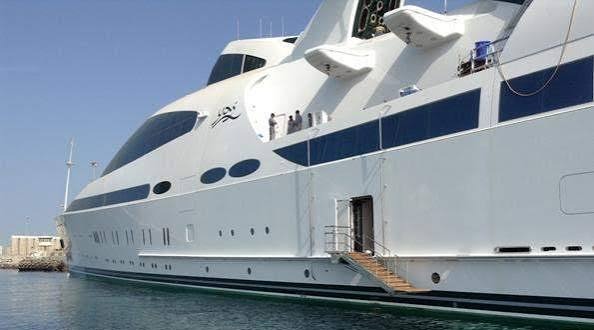
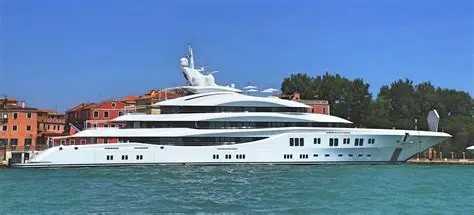
A superyacht may place greater emphasis on compact stowage, aesthetics and seamless integration.
A retrofit project introduces another set of constraints because the system has to work around an existing vessel arrangement.
Each application therefore requires a different balance of:
performance, safety, integration, reliability, maintainability and lifecycle value.
The EHL Approach to Marine Access Engineering
At EHL Group, marine gangways and accommodation ladders are approached as engineered systems rather than standalone products.
The process can encompass:
Vessel requirements
↓
Concept engineering
↓
Structural design
↓
Hydraulic and electrical integration
↓
Automation and controls
↓
Fabrication
↓
Installation
↓
Testing and commissioning
↓
Inspection and maintenance
↓
Lifecycle support and upgrades
This approach allows the access system to be considered in the context of the vessel and its operational requirements from the beginning.
Conclusion: Engineer the Access System Around the Vessel
A marine gangway may physically sit on the deck, but its engineering influence extends throughout the vessel.
Its structure interacts with the ship.
Its hydraulics interact with the power system.
Its controls interact with the operator.
Its safety systems interact with vessel procedures.
Its maintenance requirements continue throughout the vessel’s service life.
That is why effective marine access design begins with system engineering, not equipment selection.
The question should not simply be:
“What gangway do we need?”
It should be:
“What access system will best support the vessel, its people and its mission?”
That is the difference between supplying a piece of deck equipment and engineering a marine access system.
Ask the Engineer
Have a vessel access requirement that does not fit a standard specification?
EHL Group works with vessel owners, shipbuilders, naval architects and operators to engineer marine gangways and accommodation ladder systems around the vessel, its operating environment and its mission.
Engineering the Connection.
Access by Design. Performance by Engineering.
Contact: solutions@ehlsolutions.com
FAQ
Is a marine gangway considered part of the vessel’s engineering system?
Although physically mounted on the vessel, a modern marine gangway can interact with structural, hydraulic, electrical, control and safety systems. Treating it as an integrated vessel system can improve coordination between these interfaces.
What systems does a hydraulic marine gangway integrate with?
A hydraulic gangway can integrate with hydraulic power units, pumps, valves, cylinders, manifolds, hoses, electrical controls, sensors and vessel control systems. System architecture depends on the vessel and operating requirements.
Why is structural integration important for a marine gangway?
The vessel structure must accommodate the loads and reactions generated by the access system. Mounting points, foundations, pivots and local reinforcement therefore need to be considered as part of the overall engineering design.
What role do controls play in an automated accommodation ladder?
Controls coordinate system movements and can incorporate operator interfaces, position feedback, sensors, interlocks, alarms, emergency stops and fault handling. Proper control design is essential for predictable and safe operation.
What environmental conditions affect marine gangway design?
Marine access equipment can be exposed to saltwater, corrosion, wind, rain, temperature changes, vessel motion, tidal variation and repeated loading. These conditions should be incorporated into the engineering and material-selection process.
Why should marine gangway systems be tested as a complete system?
Individual components can function correctly while interactions between components create operational problems. System-level testing verifies the complete sequence of mechanical, hydraulic, electrical, control and safety functions.
What does integrated marine access engineering mean?
Integrated marine access engineering means considering the gangway, accommodation ladder, vessel structure, actuation, controls, safety systems, operator requirements and lifecycle maintenance as one coordinated engineering problem.